
Workshop recording · NACCE 2026, Boston: Why Entrepreneurs Fail Before Their Business Does
The full workshop, recorded at the NACCE 2026 Annual Conference on November 2, 2026.
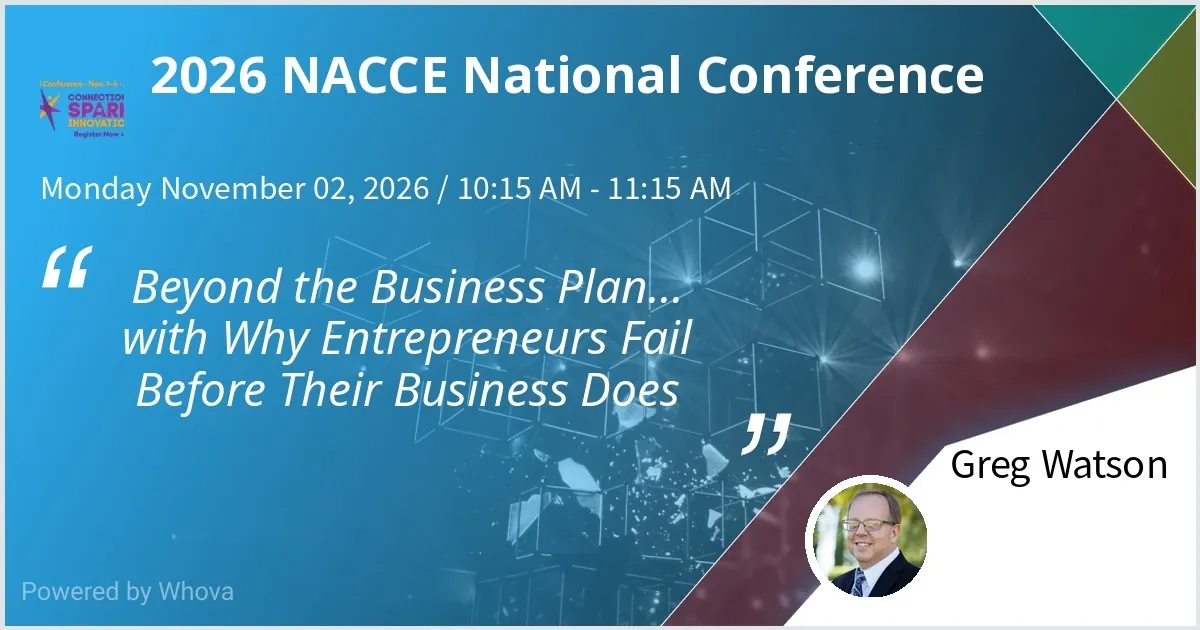
Pima Community College professor and serial entrepreneur introduces an organizational Capacity Framework to help educators recognize the warning signs of business failure long before financial collapse.
Boston, Massachusetts, November 2. “Financial bankruptcy is an event, but organizational failure is a process.”
With that central thesis, Dr. Greg Watson, Professor of Business at Pima Community College in Tucson, Arizona, challenged entrepreneurship educators to reconsider how they prepare students to launch, operate and grow successful businesses.
Speaking at the 2026 Annual Conference of the National Association for Community College Entrepreneurship (NACCE), held November 1–4 in Boston, Dr. Watson presented an interactive workshop titled “Why Entrepreneurs Fail Before Their Business Does.”
The workshop explored a frequently overlooked dimension of entrepreneurship education: the difference between developing a promising business opportunity and developing the organizational capacity necessary to execute that opportunity successfully.
Dr. Watson argued that the warning signs of business failure often appear long before financial distress becomes obvious. A company can experience rising sales, satisfied customers and expanding demand while simultaneously developing serious weaknesses in its operational systems, leadership structure, financial management and ability to scale.
“Financial bankruptcy is an event, but organizational failure is a process.”
Dr. Greg Watson, speaking at the NACCE 2026 Annual Conference, Boston, Massachusetts, November 2, 2026. Lightly edited for clarity from the recorded workshop.
His central message was that business failure is often preceded by organizational problems that educators, entrepreneurs and business advisors can learn to recognize and address.
Entrepreneurship education has traditionally placed substantial emphasis on opportunity recognition, creativity, determination, resilience, customer discovery and business model development.
Dr. Watson emphasized that these remain essential entrepreneurial strengths. However, he challenged educators to consider whether those strengths are sufficient to develop a sustainable business.
A founder may demonstrate exceptional entrepreneurial talent while the organization lacks the systems, people, processes or resources required to support its growth.
“A capable entrepreneur does not automatically build a capable organization.”
Dr. Greg Watson, during Why Entrepreneurs Fail Before Their Business Does, NACCE 2026, November 2, 2026.
This distinction lies at the heart of the Capacity Framework Dr. Watson is developing.
Rather than treating business success primarily as a function of the founder’s personal characteristics or the attractiveness of a market opportunity, the framework encourages educators and entrepreneurs to examine whether the business possesses the organizational capacity needed to deliver on its promises.
The approach also introduces a complementary dimension to traditional entrepreneurial opportunity recognition. Entrepreneurship students are routinely taught to identify problems in the marketplace and recognize opportunities to serve customers. Dr. Watson proposes that they should also learn to recognize problems and development opportunities inside their own organizations.
The Capacity Framework examines whether an enterprise has developed the organizational resources, competencies, systems and structures necessary to execute its business model.
It shifts the diagnostic question from “Is this entrepreneur capable of building the business?” to “What organizational capacity must be developed for this business to succeed?”
That distinction is intentional.
Dr. Watson described how early focus groups responded negatively to assessments framed around the founder’s “capabilities.” Participants sometimes interpreted the terminology as criticism of their personal skills or competence. When the assessment was reframed around organizational “capacity,” the conversation became more constructive. The assessment could then identify development opportunities without framing them as personal shortcomings.
The resulting educational approach emphasizes four interconnected activities:
Dr. Watson’s broader objective is to help entrepreneurship educators develop what he calls Capacity Development Literacy: the ability to recognize, evaluate and address organizational capacity gaps as businesses launch and grow.
Within this approach, the Capacity Gap Assessment is a practical diagnostic activity through which learners apply that competency to a particular enterprise.
Rather than limiting the workshop to a conceptual presentation, Dr. Watson invited conference participants to apply the framework to an interactive business case.
The case examined a growing artisan bakery operated by a talented culinary entrepreneur. The bakery had experienced increasing customer demand and expanding wholesale opportunities. Yet its growth also exposed substantial operating problems.
The founder was working approximately 75 hours per week. Production schedules changed frequently, inventory records were unreliable, deliveries were inconsistent, and much of the business depended on the founder’s direct involvement.
From a conventional entrepreneurship perspective, the bakery demonstrated several positive indicators: a desirable product, paying customers, growing demand and expansion opportunities. From an organizational capacity perspective, however, the enterprise was becoming increasingly fragile.
Working in small groups, NACCE participants evaluated the bakery’s operations and proposed practical improvements.
Their recommendations included delegating responsibilities, developing employee skills, improving production planning, implementing forecasting systems, establishing clearer customer-order policies and assessing the organization’s actual capacity to accept additional business.
One participant, drawing on personal experience operating a bakery, highlighted the practical difficulty of simultaneously fulfilling customer orders and training employees. The discussion introduced another important consideration: sometimes the appropriate response to a capacity constraint is to slow growth temporarily while strengthening the organization.
The activity demonstrated that business growth and organizational health are not necessarily the same thing.
It also illustrated how capacity assessment could become a practical learning activity within entrepreneurship courses, business-plan development, accelerator programs and student pitch competitions.
Dr. Watson emphasized that the knowledge required to build successful organizations is not missing from higher education.
Business departments already teach financial management, accounting, marketing, human resources, operations, organizational behavior, leadership and strategic management.
The challenge is that these disciplines are frequently taught separately, while entrepreneurship courses and certificate programs often concentrate on opportunity recognition and business planning.
Dr. Watson suggested that the educational opportunity lies in helping students connect these disciplines and apply them to their own enterprises.
“We do a great job of problem recognition and opportunity recognition. Those are all external. But do we do a really good job of thinking about internal opportunity recognition, internal problem recognition?”
Dr. Greg Watson, addressing entrepreneurship educators during his NACCE workshop, November 2, 2026.
A student may know how to describe a target market, forecast sales or create a compelling pitch without fully understanding what operational infrastructure the business must develop to deliver the promised product or service.
The proposed Capacity Gap Assessment offers a way to address that disconnect.
During the session, Dr. Watson reported that a capacity assessment was being tested at seven colleges, with particular emphasis on placing the assessment immediately after business model development. This was a description of ongoing educational development, not a claim of independently validated outcomes.
The intent is to help students identify the organizational requirements of their proposed businesses before those requirements become expensive operational problems.
Dr. Watson also drew on his experience as a serial entrepreneur and the founder of 14 companies.
He shared the story of his first venture, a payroll-processing company launched while he was a college student. The business experienced rapid customer acquisition and strong reported profitability, but the financial demands of supporting that growth created serious cash-flow challenges.
Over its first 18 months, Dr. Watson described borrowing approximately $1.8 million to support the company’s growth.
The experience taught him that revenue growth and profitability do not eliminate the need for financial and organizational capacity.
The company ultimately achieved a successful sale, but Dr. Watson attributed much of his ability to navigate its early challenges to the support of experienced advisors, including his banker, attorney and accountant.
In subsequent ventures, he increasingly focused on building management teams and organizational systems that could operate without depending on his personal involvement in every decision.
That experience helped shape a principle underlying his current work: the founder’s personal abilities should not become the operating limits of the enterprise.
For established business owners, the implications extend beyond business survival. Developing an organization that can function without constant founder intervention may improve scalability, continuity, leadership succession and the company’s attractiveness to potential buyers.
Dr. Watson’s workshop encouraged educators, entrepreneurship centers and business advisors to consider how organizational capacity assessment could complement existing approaches to entrepreneurial mindset development and business planning.
The framework is intended to be constructive rather than critical of traditional entrepreneurship education.
Entrepreneurial resilience, creativity and resourcefulness remain valuable. The Capacity Framework builds on those strengths by helping founders recognize when additional expertise, systems, personnel or organizational structures are needed.
For educators, the next step may be relatively straightforward: incorporate capacity assessment into existing coursework and use organizational case studies to help students practice diagnosing enterprise-level challenges.
For entrepreneurs, the opportunity is equally practical: recognize internal organizational weaknesses early enough to address them before they restrict growth or threaten business continuity.
The workshop concluded with an invitation for educators to share approaches and challenges from their own entrepreneurship programs, reinforcing the value of collaboration across community colleges.
Dr. Greg Watson is a Professor of Business at Pima Community College in Tucson, Arizona.
A serial entrepreneur and the founder of 14 companies, Dr. Watson brings extensive business development and entrepreneurial experience to his work as an educator.
His academic interests include entrepreneurship education, new venture development, entrepreneurial mindset, organizational capacity and the application of practical business frameworks to student learning and business development.
His current work explores how educators can better prepare entrepreneurs to recognize the organizational requirements of building, operating and scaling successful enterprises.
Dr. Watson also develops open educational resources, including Entrepreneurship Essentials ↗, a free open textbook supporting entrepreneurship instruction and applied business education.
The presentation, “Why Entrepreneurs Fail Before Their Business Does,” was delivered on Monday, November 2, 2026, during the 2026 NACCE Annual Conference in Boston.
The full workshop, recorded at the NACCE 2026 Annual Conference on November 2, 2026.
2026 NACCE Annual Conference ↗
The Capacity Framework, Capacity Development Literacy and Capacity Gap Assessment described here are part of Dr. Watson’s ongoing educational framework development and classroom assessment work.
A one-page summary of the workshop, the framework and the approved quotations, for reporters and conference organizers.
Download the media fact sheet (PDF, 81 KB)
Media and speaking inquiries: contact Dr. Watson.