
Pima Community College Honors Dr. Greg Watson for Earning ACUE Certificate in Effective Teaching Practice
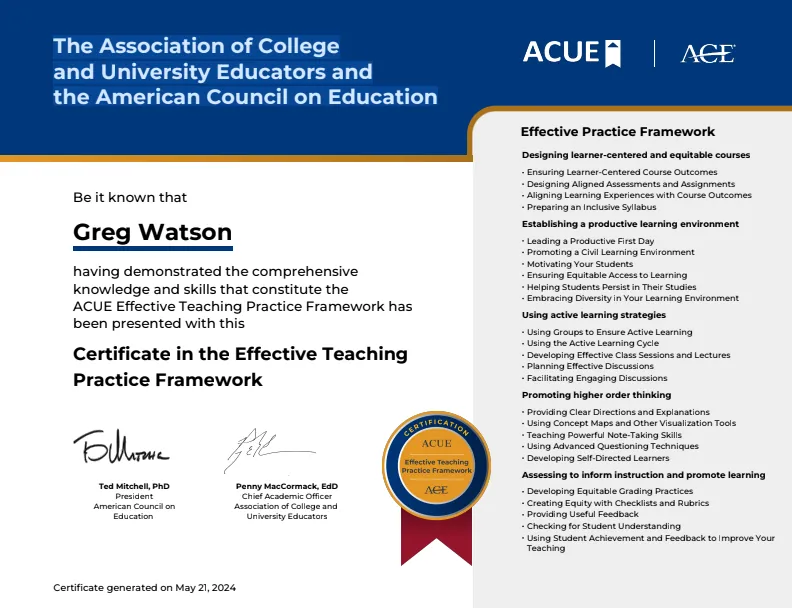
Tucson, Arizona, May 21, 2024. Pima Community College (PCC) is pleased to announce that Dr. Greg Watson, Professor of Business, has successfully completed the Certificate in Effective Teaching Practice Framework ↗ offered by the Association of College and University Educators (ACUE). This accomplishment is part of a broader initiative at PCC to enhance teaching quality and foster student success through evidence-based instructional practices.
A milestone in teaching practice
The Certificate in Effective Teaching Practice Framework demands approximately 60 hours of coursework. It is designed to equip educators with the skills necessary to create learner-centered, equitable and engaging learning environments. The program covers a broad spectrum of effective teaching practices, including:
- Establishing a productive learning environment
- Using active learning strategies
- Promoting higher-order thinking
- Assessing to inform instruction and promote learning
Dr. Watson’s completion of this program underscores his commitment to refining his teaching methods and implementing practices that enhance student outcomes.
The impact of ACUE certification
Research indicates that students in courses taught by ACUE-certified faculty experience greater academic success and higher retention rates. By adopting these teaching practices, Dr. Watson and his colleagues help advance PCC’s mission to provide high-quality, accessible education that meets the needs of its diverse student body.
“We chose to engage with ACUE because of the compelling evidence showing that students benefit tremendously from courses taught by ACUE-certified faculty,” said Dr. Kate Schmidt, Assistant Vice Chancellor for Faculty Affairs & Development. “Dr. Watson’s achievement is a shining example of the commitment our faculty have to student success.”
Honoring excellence in teaching
Dr. Watson and his fellow ACUE-certified faculty members will be honored at a pinning ceremony during All College Day on August 23, 2024, at the West Campus. The ceremony will celebrate the faculty who have completed the ACUE program and their contributions to the college’s academic community.
The pinning ceremony is a long-standing tradition within the ACUE community, symbolizing the faculty’s commitment to implementing the effective teaching practices they have learned. Each certified faculty member will be awarded a certificate and a pin.
“We are incredibly proud of our ACUE-certified faculty,” said Dr. Schmidt. “Their commitment to enhancing their teaching practices not only benefits our students but also strengthens the overall quality of education at Pima Community College.”
What the framework covers
- Ensuring learner-centered course outcomes: designing aligned assessments and assignments that reflect the course outcomes, creating an inclusive syllabus and preparing for a productive first day.
- Establishing a productive learning environment: promoting a civil learning environment, motivating students, ensuring equitable access to learning and helping students persist in their studies.
- Using active learning strategies: using groups for active learning, employing the active learning cycle and developing effective class sessions and lectures.
- Promoting higher-order thinking: planning and facilitating engaging discussions, using concept maps and other visualization tools and teaching powerful note-taking skills.
- Assessing to inform instruction and promote learning: using advanced questioning techniques, developing self-directed learners and creating equitable grading practices.
Looking ahead
The certification of Dr. Watson and his peers marks a significant step forward in PCC’s ongoing efforts to enhance teaching quality and support student achievement.
“We are committed to continuous improvement and professional development for our faculty,” said Dr. Michael Parker, Academic Dean of Social Sciences and Education. “The success of our ACUE-certified faculty is a testament to the positive impact of these initiatives on our students and the broader academic community.”